




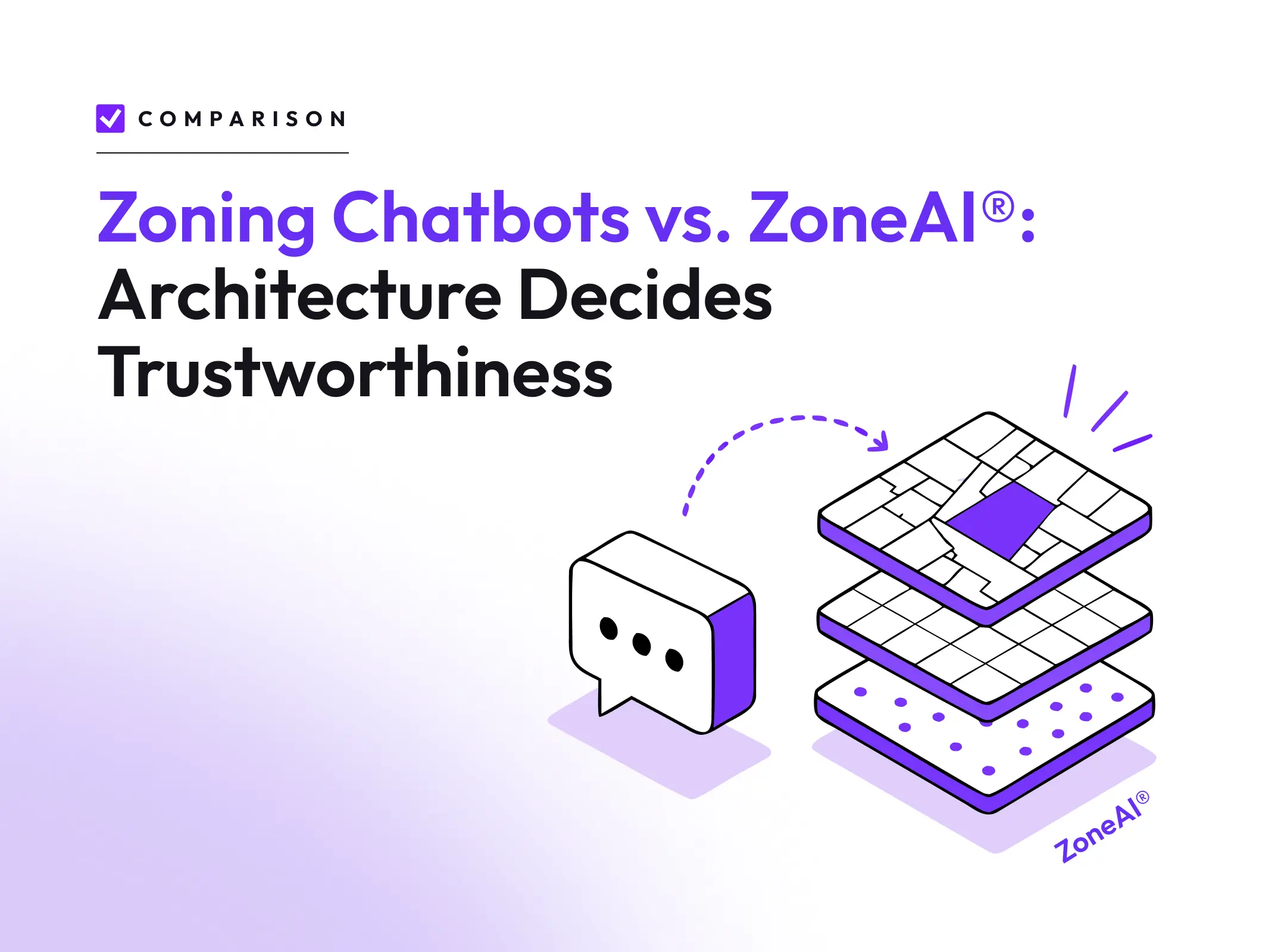
In our last post on this topic, Can You Trust AI for Zoning?, we made the case that your skepticism about AI for zoning is healthy, and that the real question is how a system arrives at its answers. That question has only become more urgent. A wave of land tools now offers the same thing: a chat box. Click a parcel, type a question about the zoning, and an LLM reads the code and writes you an answer.
It demos well. It's also the wrong architecture for a job where a confidently wrong answer can cost you a deal, a land deposit, or months of entitlement work.
This post breaks down how chatbot-based zoning tools actually work, where they fall short, and why we built ZoneAI® on a completely different foundation.
Two ways to answer a zoning question
Every AI zoning product makes one foundational choice: when does the reading of the code happen?
Chatbot-based zoning reads the code at the moment you ask. You select a parcel, type a question, and the model pulls whatever version of the ordinance it has access to, interprets it on the fly, and generates a response. Nothing exists until you ask, and the answer is written fresh every time.
ZoneAI reads the code before you ever ask. Every zoning ordinance manual is aggregated, checked for currency, extracted into structured data, QA-checked, and only then shipped to production. Zone code, permitted and conditional uses, min/max density, minimum lot area, setbacks, FAR, height, and more are stored as discrete values for every parcel, and each value cites the ordinance section, table, and page it came from.
One parcel at a time, only when asked, versus every parcel, already analyzed. Nearly every difference that follows comes back to that choice. Some tools pair a zoning map with a chatbot, but the reading still happens one parcel at a time, on demand.
To be clear, chat isn’t the problem. Asking questions in natural language is a good way to work, and ZoneAI has a conversational operating layer of its own. The problem is using chat as the source of the zoning answer, where a model reading the code on the fly is the only thing between you and a wrong setback or a missed use restriction. In ZoneAI, the conversation sits on top of zoning data that has already been structured and checked. Chat is how you ask the question. It isn’t where the answer comes from.
Where chatbot-based zoning falls short
1. Hallucination is a property of the architecture, not a bug that gets patched
Large language models generate plausible text. Most of the time plausible and correct overlap. When they don't, the model has no built-in way to tell you.
This isn't theoretical. The most rigorous public research on LLMs reading zoning comes from Urban Institute, and the findings should give any land team pause:
- March 2026 the Urban Institute built a chatbot over Minneapolis’s zoning code and tested current models, including ChatGPT 5.1. It missed rules spread across sections, confused similar district names, never asked about overlays, and gave vague users answers that were “generic, hard to understand, and sometimes incorrect.”
A hallucinated setback is a number someone writes an offer on.
2. The chatbot answers the question you asked, even when it's the wrong question
Stanford's researchers also documented what they called "contra-factual bias": models tend to accept a false premise and answer anyway.
In zoning, that looks like this. An analyst asks, "What's the minimum lot size for townhomes in the R-2 district?" If townhomes aren't permitted in R-2, a well-behaved system should say so. A chatbot is inclined to find a number and hand it back. The analyst walks away with a lot size for a use that was never allowed.
Structured data doesn't have this failure mode. Townhomes are either in the permitted-use field for that district, in the conditional-use field, or not there at all.
3. You don't know which version of the code it read
Ordinances get amended constantly: new overlay districts, revised density caps, updated parking standards, rezonings approved last month. A chatbot's answer is only as current as whatever copy of the code it retrieved, and that copy is often out of date. Most chat interfaces never tell you which version they read or when it was last refreshed.
ZoneAI checks every ordinance for currency before extraction, and every value is tied to a specific section, table, and page you can open and read yourself.
4. Ask twice, get two answers
Generated answers vary. Rephrase the question, ask it on a different day, or have two analysts ask it in their own words, and you can get different outputs from the same code. That makes it very hard to standardize how an acquisition team underwrites a site, and nearly impossible to audit later why a decision was made.
A structured value doesn't change based on who's asking or how. The minimum lot area for a district is the same number for your VP of Land, your newest analyst, and your investment committee.
5. The verification burden lands back on your team
A chat response that summarizes the code without pinpointing where each number came from hasn't saved your team the work. It has just moved it. Someone still has to open the ordinance, find the right table, and confirm the answer before it goes into an offer. Multiply that across every parcel in a pipeline and the time savings disappear.
With ZoneAI, every value cites its source. Checking an answer takes seconds, not a trip back through a 400-page PDF.
6. A chatbot can describe one parcel. It can't search a market.
This is the limitation that matters most for growth. A chatbot works one parcel at a time, and only after you've already found the parcel. It can't answer, "Show me every parcel in this county where I can build 12 units per acre by right," because you can’t filter a market on a value that doesn’t exist until someone asks for it.
Because ZoneAI stores zoning as structured data, it becomes searchable criteria:
- SearchAI™ lets teams search for land by what they want to build, including the permitted and conditional uses that hide in zones you'd never think to check.
- SiteAI™ injects ZoneAI values directly into site planning, so yield estimates reflect the actual code, including current zoning and rezoning scenarios, in minutes.
A chatbot's answer ends in a paragraph of text. A ZoneAI value flows into every step of the acquisition workflow that comes after it.
7. A blank chat box is an adoption barrier
Chat interfaces assume every user knows what to ask, how to phrase it, and how to judge the response. In practice, that means the tool gets used by the few people who are comfortable prompting it, and the rest of the team goes back to the county website.
When zoning answers are already on the parcel, there's nothing to prompt. Enterprise clients using Prophetic averaged a 95.3% daily active use rate over a 12-month study period.
Side by side
What this looks like in the field
The value of a verifiable answer shows up most when there's a landowner on the other end of the phone.
"There's actually a link to the zoning ordinance in Prophetic, which has been really helpful for us. If we've got the owner on the phone, I'm going right to the parcel, pulling all the information and sounding really, really smart about their parcel." — Alex Monero, Principal Director of Land Acquisition, The Gove Group
"For me to give a landowner a real number backed by data that feels legitimate would previously have taken a ton of time. Now with Prophetic, I can feel pretty confident in the zoning, the output, the wetlands, the steep slopes." — Alex Monero, The Gove Group
Confidence in the number is what makes it possible to move fast. If your team has to double-check every answer a tool gives them, they won't use it when the pressure is on.
How to test any zoning AI before you commit
Don't take any vendor's word for it, including ours. Run every zoning tool you're evaluating through these tests:
- Ask the same question twice. Rephrase it the second time, or have a colleague ask it. Do you get the same answer?
- Ask a false-premise question. Ask for the minimum lot size of a use you know isn't permitted in a district. Does the tool correct you, or give you a number?
- Check the citation. Can you click through to the exact ordinance section, table, and page? Does it match what the tool told you?
- Check the version. Pick a jurisdiction with a recent zoning amendment. Does the answer reflect it?
- Time it. How long does it take to establish minimum lot size, min/max density, and setbacks for a zone in a municipality you know well?
- Search a market. Try to find every parcel in a county where your product type is permitted by right. Can the tool do it at all?
The tools that pass these tests are the ones your team can actually underwrite on.
The bottom line
Chatbots are a fine way to explore a question. They are a risky way to answer one when real capital depends on it. Zoning determinations should be structured, current, consistent, and cited, and they should be ready for every parcel in your market before anyone thinks to ask.
That's what ZoneAI was built to do.
Bring a real site. We'll run it through ZoneAI live and show you exactly what the code says, where it comes from, and how every value flows into search and site planning. Schedule a demo.

