




Every land team is operating on an acquisition process that is only as good as the tools they use and the systems that hold it all together. It might be in a spreadsheet a senior manager built years ago. It might be in a shared drive with a folder of templates. It might be in the muscle memory of the team members who have been there longest. Wherever it lives, the question every team should ask is the same: Is limiting the quality and quantity of what we can accomplish? The answer for most teams today is yes.
The reason isn’t that your team lacks discipline. It’s that the tools available to land teams have forced the work into a stack of disconnected systems, and no amount of process documentation can hold that stack together. The pipeline lives in one tool. Tasks live in another, or in spreadsheets, or in email threads. Required documents live in a shared drive that nobody updates consistently. Diligence steps get tracked on a checklist that gets emailed around, falls out of sync within days, and varies by whoever’s running the deal that week. As a result there are missed opportunities, additional costs, and unnecessary risks.
When the process lives across that many tools, visibility, repeatability, and the ability to make transformative change is limited. The senior manager who built the playbook can describe what good looks like, but they can’t make sure good actually happens on every deal. The Division President who reviews pipeline reports can see where deals are, but not whether the right work is getting done at each stage. New hires learn by stitching together fragments from three different systems, which is why their ramp time is measured in quarters instead of weeks.
The teams pulling ahead in 2026 are the ones that have stopped trying to fix the process and started fixing the system underneath it. When the work, the deal record, the documents, and the collective insights all live in the same system, the process can finally run on something other than memory and discipline. That’s the shift that lets a team run their best process on every deal, regardless of who’s doing the work and regardless of how big the team gets.
What scales isn’t the tools. It’s the system underneath them.
Land teams are trying to do more with the same headcount. More markets. More deals in motion. More acquisitions evaluated per quarter. The constraint isn’t ambition. It’s the friction that builds up every time the team has to move information between tools that don’t talk to each other.
The process you’ve built is the thing that makes your team yours. The taste your senior people bring to evaluating deals. The vendor relationships that move faster than market rate. The sequence your team has refined for diligence that catches problems early. The collective judgment about which deals are worth the team’s time. None of that is theoretical. It’s accumulated, real, and uncopyable. Tasks are the scaffolding around it, either expanding what the team can build or limiting it.
When the scaffolding is fragmented across tools, the team’s best work gets diluted in the gap. Spreadsheets fall out of sync within days. Email threads scatter across inboxes. Critical decisions made in one system never reach the place where the next decision gets made. The team’s collective judgment ends up running on memory and reminders rather than on a system that surfaces the right context at the right moment.
The platform layer your team needs is one that does three things at once: codifies what good looks like, applies it automatically as deals progress, and gives every team member the visibility to act on the same standard.
That’s what we built with Task Generation.
How Task Generation works
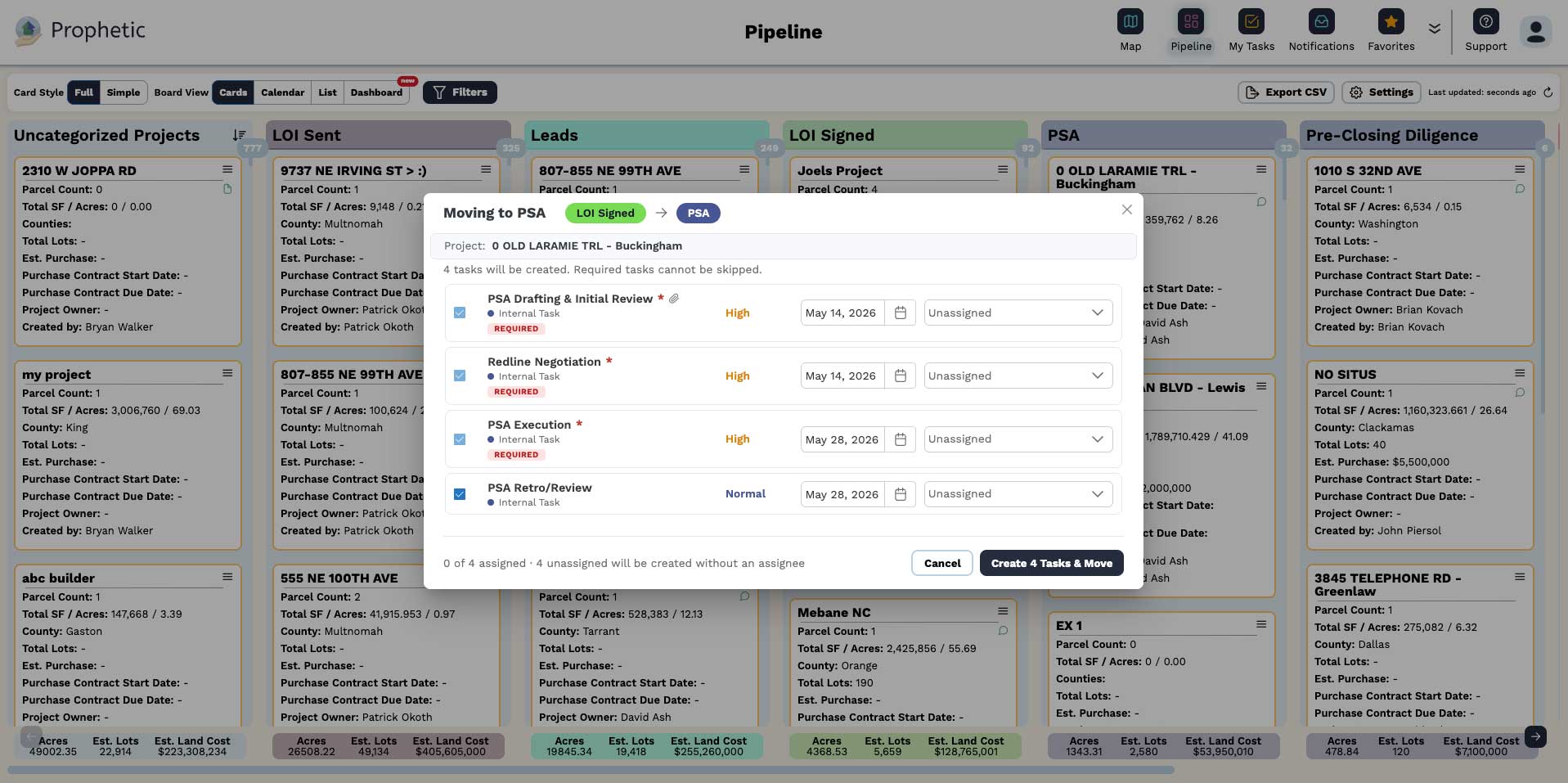
Task Generation is part of LRMTM, Prophetic’s Land Relationship Manager and the system of record for every deal your team is working. As a project advances through your pipeline, the platform automatically generates the tasks required for that stage, organized and ready to assign. No one has to remember what comes next. No one has to build a checklist from scratch. The platform applies your team’s playbook to every deal, every time.
Three mechanics make this work as more than a task generator.
Your standard, applied automatically. When your team has marked a task as required for a given stage, every deal that reaches that stage gets it, in the same form, with the same expectation. The diligence sequence your senior people refined over years runs on every deal your newest hire is working. The standard that used to depend on someone remembering it now runs on the platform itself. For high-stakes diligence work, that consistency is the difference between a clean deal record and a problem discovered at closing.
The deal record builds itself. When a task requires a specific document, like a Phase I, a survey, or a title commitment, the document gets attached at the moment the work is complete. The deal record stays current in real time. Every required document is present without anyone chasing for it. The audit trail that used to take hours to assemble at closing is already there, built quietly in the background as the work happens.
Best judgment, deal by deal. Not every deal fits the standard template. Some tasks are non-negotiable on every deal. Some deals require flexibility. Task Generation lets the team member moving the deal make that call in the moment, deal by deal, without going to an admin or filing a ticket. The judgment your best people have always brought to deal-by-deal decisions stays with them, applied through the system rather than around it.
The combined effect is consistency where the team needs it, judgment where the deal needs it, and visibility across the whole organization either way. The process your team has refined runs the same on every deal, every team member, every division. The exceptions get handled by the person closest to the deal, with full context and no friction.
What this looks like for your team
Three before-and-after stories from teams running on Prophetic.
A new hire's first week, transformed. A Senior Investment Analyst at a commercial industrial development firm joined his team needing to source industrial outdoor storage parcels in markets he had never operated in. Before Prophetic, that meant hours per market navigating municipal zoning databases to confirm permitted uses, with no shortcut to building a target list and no path to surfacing landowners directly. New markets were the hardest. There was no fast way to get from "I need to operate here" to "I'm calling owners."
With Prophetic, by the end of his first week, he had built a 100-property prospect list across Stockton, Modesto, and Merced, with owner contact information surfaced at the parcel level. He was on the phone with target property owners in the same week he got access to the platform. The zoning research that used to consume hours of his time was handled by Prophetic's SearchATMI, and the contact information that used to require separate databases was already attached to the parcels he was evaluating.
The transformation: a new team member operating at the team's standard in days instead of months, because Prophetic gave him the same intelligence layer his senior colleagues use.
Read the full story
A senior leader's time, redirected. A Director of Land Acquisition at a multi-state developer used to spend hours each week answering "what's next" questions from junior team members, chasing required documents across email and shared drives, and reconstructing deal histories for management reviews. Training a new hire took months because the team's playbook lived in his head and in fragmented checklists.
With Prophetic, his team trains new hires in days rather than months. Task Generation tells the new team member exactly what to do at each stage, what documents are required, and what the team has done on similar deals before. The "what's next" questions disappear because the platform answers them automatically. The hours that used to go into chasing and reconstruction now go into finding the next deal.
The transformation: a senior leader operating as a force multiplier on the team's pipeline rather than a bottleneck on the team's questions, because Prophetic captured the playbook he used to carry alone.
Read the full story
A multi-division operation, standardized. Builders running multiple divisions have historically run multiple slightly different versions of the same process, because each division evolved its own institutional history and tribal knowledge. Pipeline reports rolled up cleanly. Process consistency did not. A great quarter in one division was hard to replicate in another, because what made it work lived in the senior team there rather than in a shared system.
With Prophetic, the same playbook runs across every division. The variance disappears. The standard improves because every division contributes to the same template, and every refinement compounds across the whole organization. Outperforming divisions become repeatable. Underperforming divisions become visible early. Process gaps surface in real time rather than at quarterly review.
The transformation: a multi-division operation running on one operating standard rather than twelve slightly different ones, because Prophetic gave the organization a single platform underneath the work.
That's the moat. Not a feature, not a tool, but a system that turns the process you've built into the operational standard your entire organization runs on, with Prophetic as the layer that makes it possible.
Why this matters now
The teams running on Prophetic today are spending this quarter compounding their process advantage while their competitors are still managing fragmented stacks of disconnected tools. That compounding shows up in concrete ways. A new division comes online and runs at the same standard as your best one from day one. A new hire produces standard-quality work in their first quarter instead of their third. A senior leader's time goes to finding the next deal instead of reconstructing the last one. A deal gets across the line because the platform surfaced what someone might have missed.
None of these advantages are theoretical. They are happening right now, on Prophetic, for teams that decided to stop trying to fix their process and started fixing the system underneath it.
The window to build that compounding is open now.
Want to see how Task Generation works in your team’s actual workflow? Schedule a demo and we’ll walk through how Prophetic Enterprise customers are codifying their process today.